Supply Chain Attacks: When Service Providers Become the Gateway
26. June, 2026

With NIS2, a topic that has long received comparatively little attention is moving into the spotlight: supply chain security.
Even when an organisation’s systems, processes and security controls are well protected, vulnerabilities at external partners can provide attackers with an entry point. As a result, IT and security teams must look beyond their own infrastructure and consider risks that originate outside their organisational boundaries.
Cybercriminals and state-sponsored threat actors increasingly operate according to economic principles. Direct attacks against well-protected organisations are often time-consuming and resource-intensive while service providers and other organisations within the supply chain offer a far more attractive alternative: if a single partner’s infrastructure is compromised, attackers may gain access to numerous customer environments at the same time.
ENISA has consistently identified supply chain attacks as one of the most significant cybersecurity threats facing businesses and public-sector organisations. What makes these attacks particularly dangerous is their ability to bypass traditional security controls by exploiting trusted relationships.
Small and medium-sized enterprises (SMEs) face a double challenge when it comes to supply chain attacks. On the one hand, they often rely heavily on external service providers. On the other, they frequently serve as stepping stones to larger organisations, critical infrastructure operators and government entities.
A compromised email account or a hijacked service provider connection may be all an attacker needs to launch convincing phishing or business email compromise (BEC) campaigns against larger targets.
Service providers are not targeted at random. Attackers tailor their methods to the technologies and processes that organisations rely on.
The regulatory response to this threat landscape is clear. The NIS2 Directive places greater emphasis on supply chain security as part of an organisation’s overall risk management strategy.
Affected organisations must systematically assess risks arising from suppliers and service providers and demonstrate that appropriate safeguards are in place.
In practice, this means:
Supply chain security starts with visibility and control. The following measures should form part of every cybersecurity strategy:
Supply chain risks are not limited to cyberattacks. Technical failures and misconfigurations at critical service providers can also have significant consequences. The global CrowdStrike outage in July 2024 demonstrated how a faulty update from a single vendor can disrupt thousands of organisations simultaneously — even without a cyberattack.
Protecting internal systems remains the foundation of any effective cybersecurity strategy. At the same time, organisations must address risks that originate beyond their own infrastructure.
External connections should never be treated as automatically trustworthy. Zero Trust principles, least privilege, continuous monitoring and systematic supply chain risk assessments are increasingly becoming standard practice in modern cybersecurity programmes.
Sources:
https://www.bsi.bund.de/DE/Themen/Regulierte-Wirtschaft/NIS-2-regulierte-Unternehmen/NIS-2-Infopakete/NIS-2-Lieferkette/NIS-2-Lieferkette_node.html
https://www.enisa.europa.eu/publications/enisa-threat-landscape-2025>
https://www.nis.gv.at/nis-2-richtlinie.html
 https://www.ikarussecurity.com/wp-content/uploads/2026/09/MFA-de-1.png
400
600
IKARUS
https://www.ikarussecurity.com/wp-content/uploads/2026/02/IKARUS-Security-Logo-2.png
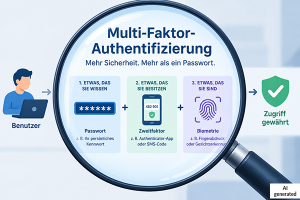
IKARUS2026-09-14 14:46:442026-09-14 14:46:45MFA Fatigue: The Risk Behind Push Approvals
https://www.ikarussecurity.com/wp-content/uploads/2026/09/MFA-de-1.png
400
600
IKARUS
https://www.ikarussecurity.com/wp-content/uploads/2026/02/IKARUS-Security-Logo-2.png
IKARUS2026-09-14 14:46:442026-09-14 14:46:45MFA Fatigue: The Risk Behind Push Approvals https://www.ikarussecurity.com/wp-content/uploads/2023/05/ransomware-2.jpg
338
600
IKARUS
https://www.ikarussecurity.com/wp-content/uploads/2026/02/IKARUS-Security-Logo-2.png
IKARUS2026-04-28 09:39:482026-04-28 09:41:39Ransomware is changing: from encryption to data Theft
https://www.ikarussecurity.com/wp-content/uploads/2023/05/ransomware-2.jpg
338
600
IKARUS
https://www.ikarussecurity.com/wp-content/uploads/2026/02/IKARUS-Security-Logo-2.png
IKARUS2026-04-28 09:39:482026-04-28 09:41:39Ransomware is changing: from encryption to data Theft https://www.ikarussecurity.com/wp-content/uploads/2026/03/ENISA-Threat-Landscape-Report-2025-.png
424
300
IKARUS
https://www.ikarussecurity.com/wp-content/uploads/2026/02/IKARUS-Security-Logo-2.png
IKARUS2026-03-10 10:49:242026-03-10 11:06:01Cyber Threats in Europe
https://www.ikarussecurity.com/wp-content/uploads/2026/03/ENISA-Threat-Landscape-Report-2025-.png
424
300
IKARUS
https://www.ikarussecurity.com/wp-content/uploads/2026/02/IKARUS-Security-Logo-2.png
IKARUS2026-03-10 10:49:242026-03-10 11:06:01Cyber Threats in Europe https://www.ikarussecurity.com/wp-content/uploads/2026/03/IKARUS_Logo-red-rgb-350.png
84
350
IKARUS
https://www.ikarussecurity.com/wp-content/uploads/2026/02/IKARUS-Security-Logo-2.png
IKARUS2026-03-02 10:06:202026-03-02 10:06:29New Company Name and New Office Address as of March 1, 2026
https://www.ikarussecurity.com/wp-content/uploads/2026/03/IKARUS_Logo-red-rgb-350.png
84
350
IKARUS
https://www.ikarussecurity.com/wp-content/uploads/2026/02/IKARUS-Security-Logo-2.png
IKARUS2026-03-02 10:06:202026-03-02 10:06:29New Company Name and New Office Address as of March 1, 2026 https://www.ikarussecurity.com/wp-content/uploads/2026/02/BSI-DSZ-BSZ-0021-2025_IT-Sicherheitszertifikat_eng12019.png
753
752
IKARUS
https://www.ikarussecurity.com/wp-content/uploads/2026/02/IKARUS-Security-Logo-2.png
IKARUS2026-02-02 16:12:312026-02-02 16:18:51BSI-certified EDR agent for HarfangLab Guard feat. IKARUS
https://www.ikarussecurity.com/wp-content/uploads/2026/02/BSI-DSZ-BSZ-0021-2025_IT-Sicherheitszertifikat_eng12019.png
753
752
IKARUS
https://www.ikarussecurity.com/wp-content/uploads/2026/02/IKARUS-Security-Logo-2.png
IKARUS2026-02-02 16:12:312026-02-02 16:18:51BSI-certified EDR agent for HarfangLab Guard feat. IKARUS https://www.ikarussecurity.com/wp-content/uploads/2024/10/HarfangLab-Guard-400.jpg
285
400
IKARUS
https://www.ikarussecurity.com/wp-content/uploads/2026/02/IKARUS-Security-Logo-2.png
IKARUS2026-01-27 11:45:072026-01-27 11:47:47Austrian Universities Move Toward European Endpoint Security with Data Sovereignty
https://www.ikarussecurity.com/wp-content/uploads/2024/10/HarfangLab-Guard-400.jpg
285
400
IKARUS
https://www.ikarussecurity.com/wp-content/uploads/2026/02/IKARUS-Security-Logo-2.png
IKARUS2026-01-27 11:45:072026-01-27 11:47:47Austrian Universities Move Toward European Endpoint Security with Data Sovereignty https://www.ikarussecurity.com/wp-content/uploads/2025/12/Attack-Surface-Management-600.jpg
467
600
IKARUS
https://www.ikarussecurity.com/wp-content/uploads/2026/02/IKARUS-Security-Logo-2.png
IKARUS2025-12-09 11:49:312025-12-09 11:49:32Attack Surface Management (ASM)
https://www.ikarussecurity.com/wp-content/uploads/2025/12/Attack-Surface-Management-600.jpg
467
600
IKARUS
https://www.ikarussecurity.com/wp-content/uploads/2026/02/IKARUS-Security-Logo-2.png
IKARUS2025-12-09 11:49:312025-12-09 11:49:32Attack Surface Management (ASM) https://www.ikarussecurity.com/wp-content/uploads/2025/12/1-_NDI9048.jpg
1281
1920
IKARUS
https://www.ikarussecurity.com/wp-content/uploads/2026/02/IKARUS-Security-Logo-2.png
IKARUS2025-12-03 11:57:522025-12-03 11:57:53Digital sovereignty in practice: IKARUS and HarfangLab as a success story for European cybersecurity
https://www.ikarussecurity.com/wp-content/uploads/2025/12/1-_NDI9048.jpg
1281
1920
IKARUS
https://www.ikarussecurity.com/wp-content/uploads/2026/02/IKARUS-Security-Logo-2.png
IKARUS2025-12-03 11:57:522025-12-03 11:57:53Digital sovereignty in practice: IKARUS and HarfangLab as a success story for European cybersecurity https://www.ikarussecurity.com/wp-content/uploads/2025/11/NOZOMI-EMEA-MSSP-Award-2025-web.png
420
595
IKARUS
https://www.ikarussecurity.com/wp-content/uploads/2026/02/IKARUS-Security-Logo-2.png
IKARUS2025-11-24 12:36:312025-11-24 12:36:31IKARUS Named ‘EMEA MSSP of the Year 2025’ by Nozomi Networks
https://www.ikarussecurity.com/wp-content/uploads/2025/11/NOZOMI-EMEA-MSSP-Award-2025-web.png
420
595
IKARUS
https://www.ikarussecurity.com/wp-content/uploads/2026/02/IKARUS-Security-Logo-2.png
IKARUS2025-11-24 12:36:312025-11-24 12:36:31IKARUS Named ‘EMEA MSSP of the Year 2025’ by Nozomi Networks https://www.ikarussecurity.com/wp-content/uploads/2025/11/iot-general-AI-generated.jpg
130
300
IKARUS
https://www.ikarussecurity.com/wp-content/uploads/2026/02/IKARUS-Security-Logo-2.png
IKARUS2025-11-07 11:46:412026-08-02 13:43:41ASCON: New NIST Standard for Lightweight IoT Cryptography
https://www.ikarussecurity.com/wp-content/uploads/2025/11/iot-general-AI-generated.jpg
130
300
IKARUS
https://www.ikarussecurity.com/wp-content/uploads/2026/02/IKARUS-Security-Logo-2.png
IKARUS2025-11-07 11:46:412026-08-02 13:43:41ASCON: New NIST Standard for Lightweight IoT Cryptography https://www.ikarussecurity.com/wp-content/uploads/2025/10/mail-security-firewall-300-AI-generated.jpg
200
300
IKARUS
https://www.ikarussecurity.com/wp-content/uploads/2026/02/IKARUS-Security-Logo-2.png
IKARUS2025-10-06 16:04:082026-08-02 13:45:42The Interaction Between Firewall and Email Security
https://www.ikarussecurity.com/wp-content/uploads/2025/10/mail-security-firewall-300-AI-generated.jpg
200
300
IKARUS
https://www.ikarussecurity.com/wp-content/uploads/2026/02/IKARUS-Security-Logo-2.png
IKARUS2025-10-06 16:04:082026-08-02 13:45:42The Interaction Between Firewall and Email Security https://www.ikarussecurity.com/wp-content/uploads/2025/09/Mitsubishi_Electric-Nozomi.png
400
600
IKARUS
https://www.ikarussecurity.com/wp-content/uploads/2026/02/IKARUS-Security-Logo-2.png
IKARUS2025-09-10 14:06:592025-09-10 14:07:00Customer Information: Acquisition of Nozomi Networks by Mitsubishi Electric
https://www.ikarussecurity.com/wp-content/uploads/2025/09/Mitsubishi_Electric-Nozomi.png
400
600
IKARUS
https://www.ikarussecurity.com/wp-content/uploads/2026/02/IKARUS-Security-Logo-2.png
IKARUS2025-09-10 14:06:592025-09-10 14:07:00Customer Information: Acquisition of Nozomi Networks by Mitsubishi Electric https://www.ikarussecurity.com/wp-content/uploads/2025/08/WildeTiere-Wasserloch-300-AI-generated.jpg
200
300
IKARUS
https://www.ikarussecurity.com/wp-content/uploads/2026/02/IKARUS-Security-Logo-2.png
IKARUS2025-08-13 11:17:172026-08-02 13:47:33Watering Hole Attacks: How They Work, the Risks, and Protection Strategies
https://www.ikarussecurity.com/wp-content/uploads/2025/08/WildeTiere-Wasserloch-300-AI-generated.jpg
200
300
IKARUS
https://www.ikarussecurity.com/wp-content/uploads/2026/02/IKARUS-Security-Logo-2.png
IKARUS2025-08-13 11:17:172026-08-02 13:47:33Watering Hole Attacks: How They Work, the Risks, and Protection Strategies https://www.ikarussecurity.com/wp-content/uploads/2025/07/Computerhardware-aus-den-80ern-auf-einem-Mistplatz-AI-generated.jpg
234
300
IKARUS
https://www.ikarussecurity.com/wp-content/uploads/2026/02/IKARUS-Security-Logo-2.png
IKARUS2025-07-24 13:18:212026-08-02 13:49:44Legacy Systems: How Outdated Hardware and Software Threaten Corporate Security
https://www.ikarussecurity.com/wp-content/uploads/2025/07/Computerhardware-aus-den-80ern-auf-einem-Mistplatz-AI-generated.jpg
234
300
IKARUS
https://www.ikarussecurity.com/wp-content/uploads/2026/02/IKARUS-Security-Logo-2.png
IKARUS2025-07-24 13:18:212026-08-02 13:49:44Legacy Systems: How Outdated Hardware and Software Threaten Corporate Security https://www.ikarussecurity.com/wp-content/uploads/2025/07/Windows-Zero-Day.jpg
607
800
IKARUS
https://www.ikarussecurity.com/wp-content/uploads/2026/02/IKARUS-Security-Logo-2.png
IKARUS2025-07-10 13:23:132025-07-10 13:23:15Zero-Day Vulnerability in Windows Shortcuts
https://www.ikarussecurity.com/wp-content/uploads/2025/07/Windows-Zero-Day.jpg
607
800
IKARUS
https://www.ikarussecurity.com/wp-content/uploads/2026/02/IKARUS-Security-Logo-2.png
IKARUS2025-07-10 13:23:132025-07-10 13:23:15Zero-Day Vulnerability in Windows Shortcuts https://www.ikarussecurity.com/wp-content/uploads/2025/06/OWASP-Top-10.jpg
166
304
IKARUS
https://www.ikarussecurity.com/wp-content/uploads/2026/02/IKARUS-Security-Logo-2.png
IKARUS2025-06-18 14:37:552025-06-20 11:03:57OWASP Top 10 for LLMs: New Security Challenges due to AI
https://www.ikarussecurity.com/wp-content/uploads/2025/06/OWASP-Top-10.jpg
166
304
IKARUS
https://www.ikarussecurity.com/wp-content/uploads/2026/02/IKARUS-Security-Logo-2.png
IKARUS2025-06-18 14:37:552025-06-20 11:03:57OWASP Top 10 for LLMs: New Security Challenges due to AI
 MFA Fatigue: The Risk Behind Push Approvals
Scroll to top
MFA Fatigue: The Risk Behind Push Approvals
Scroll to top